

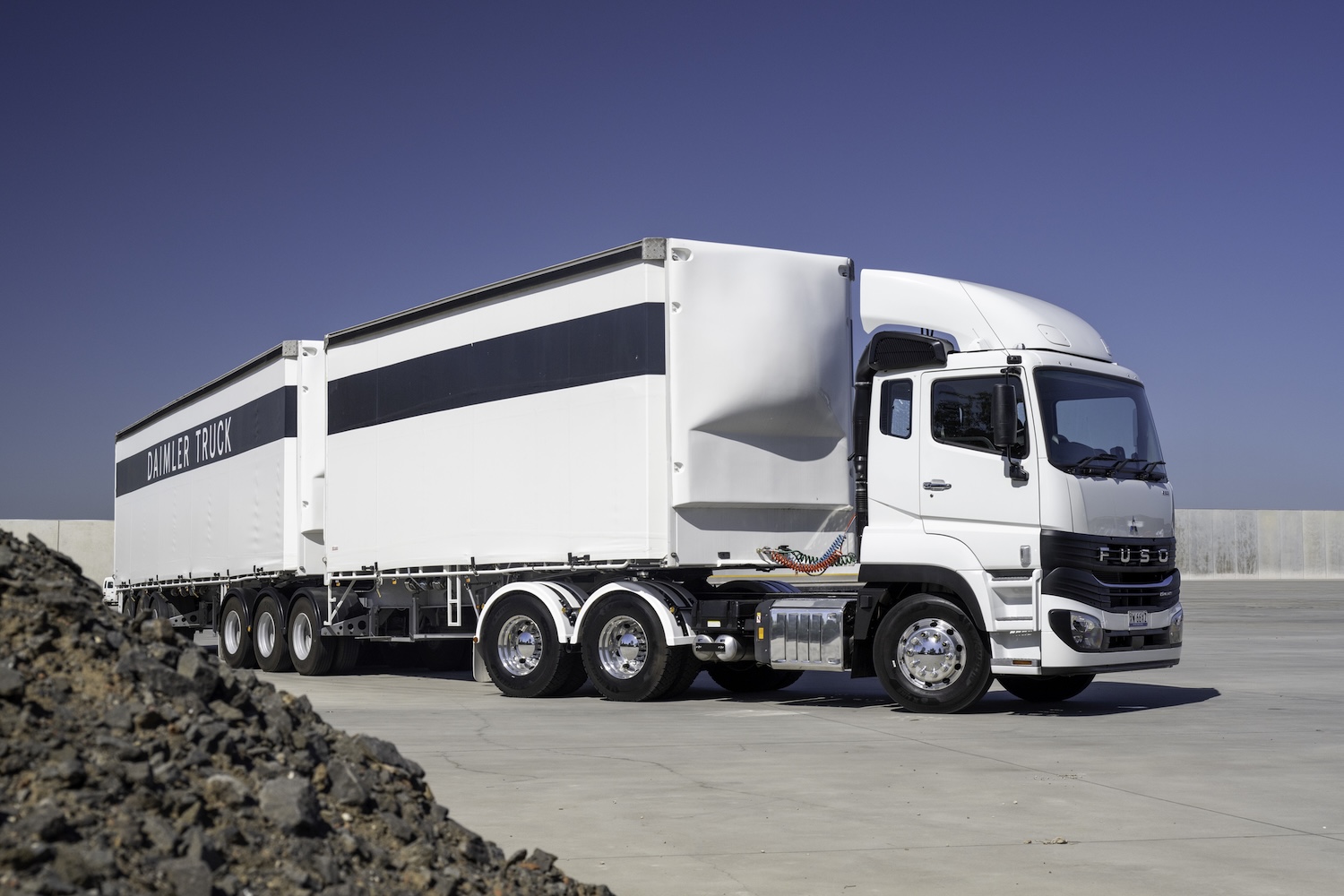
Warren Aitken recently got to put FUSO’s latest Shogun model to the test, heading out west from Melbourne to see how the truck performed along hills and highways.
1997. That was the last time I was anywhere near a FUSO truck, that’s 29 years ago. 29 years is a very long time – to put it into perspective, it is 156,000 viewings of Smokey and the Bandit,138,000 viewings of Convoy or if you happen to be that way inclined, it’s 157,000 viewings of Maximum Overdrive.
Back then it was all about the old FV433J model, the Twin Turbo Intercooler Version Shogun, with the mighty 8DC9 engine, putting out a whopping 430hp and around 1,500Nm of torque. Yes, admittedly I reckon with the old manual gearbox and my intermediate skills back then I may have left a few gear teeth on the side of the road, but I really did enjoy the challenge of driving that truck. So, getting the invite to have a play in FUSO’s newest release, I thought who wouldn’t want to see what’s changed in nearly 30 years?
FUSO was already leading the Japanese heavy duty truck market when it came to high horsepower with its 510hp Shogun, but its latest release now solidifies and extends its lead. The Shogun FV84, with the latest iteration of its 13 litre (12.8 litre if you want to be precise) 6R30 engine, now peaks at 530hp at 1,600 rpm, and 2,600Nm of torque at 1,100rpm, putting it around 50hp and 400Nm higher than its closest Japanese competitor. The state-of-the-art twin turbo 6-cylinder engine hasn’t just upped its numbers, it has also doubled down on its efficiency with word of a three per cent improvement in fuel economy. Oh, and we can’t forget the 70-tonne Gross Combination Mass rating, meaning this little Japanese rocket can be hooked up to a B-double and set off to work, which is exactly what I aimed to do with it – well, aside from the actual work side.
While a warm sunny day in Melbourne may sound like a bit of an oxymoron, it is exactly what greeted me as I jumped off the big tin taxi and caught an Uber to the Daimler Trucks dealership in Laverton, Melbourne. Upon arrival I was greeted with the big silver smile of the redesigned FUSO Shogun front grill. Parked prominently before the dealership doors, the fresh design of the FUSO has seen the composite plastic shaped into an unintentional smile directly below the FUSO badging. It has a bit of a toothless grin look to it when you get up close however, with quite a sizable gab in the middle of the grill. I did question that, seeing as you can put your arm all the way through to the radiator, and I was dutifully informed that our Kiwi whanau (who have had the new Shogun for a few months already) have already designed a protective guard for that area and it will likely end up on the Aussie variants as well.
The other thing you notice is how much more of the front façade is covered compared to the previous model. The designers have also moved the FUSO branding down. Where it used to sit directly below the window, it has moved lower, which opens up more area for company logos on the front of the new model. I’m not sure if that was deliberate, but it is a bonus for branding. There have been a few other cosmetic improvements as well in the new model, most are very subtle but extremely effective, like the entrance steps. Previous models had them pretty much stacked up and down, whereas now you can see each step is stepped out a little. It’s nothing glaringly obvious, but enough to just make entering the truck safer and easier. I was a big fan of how the designers have integrated the compulsory radar sensors into the design of the vehicle. The 270-degree system that helps with all the new safety requirements on vehicles features multiple sensors around the truck. Check out the images and you can see how unintrusive they are.
The Japanese have never led the market in sex appeal when it comes to their trucks and there’s no sugar coating that. What they do focus on is practical, built for purpose trucks and that is exactly what the Shogun FV84 is. There is no laundry list of build options when it comes to the FUSO range. Basically, they have designed only a handful of set ups and configurations for specific roles, roles their trucks are perfectly suited for. Be it in a 6×2, 6×4 or 8×4 configuration, varied among their Shogun 360, 400, 460 or 530 range, FUSO have focused on keeping their costs competitive by building what they are good at and attracting customers that require set ups FUSO are dedicatedly designed to perform in.
I would do a terrible job if I was required to list my turns and streets on the two hour test drive – I don’t know Melbourne that well and am happy not to get too acquainted. Suffice to say, we left the Laverton depot and headed in the direction of Ballarat. The first thing you do notice with the FUSO is the heaviness of the steering. It’s not old school pre power steering heavy, but you aren’t spinning the wheel with a finger. Personally, at the slower speeds, I was a fan. You get a real feel for your turn when you can actually feel your turn, and the FUSO really could turn. With an empty single I reckon you could flick the unit round in a Coles carpark, but with a fully loaded B-double I wasn’t aiming to peel any tyres off the rims. The spec sheet lists the kerb to kerb turning as an impressive 13.2 metres.
The FUSO G330-12 12-speed automated manual box did a pretty good job on the flat roads around Laverton, pulling out of the lights and negotiating corners, it did its job well. It did struggle a little more with its choices when you were pulling out from an upward off ramp or the likes – a couple of times it jumped too early in the choices and had to work to pull itself out or, in one case, second guessed itself and went back down. But on highway and after the take off changes, it seemed pretty much solid. On the uphill climbs it partnered very well with the engine and utilised the full torque curve.
Before we get to my nit picking, we should focus on the highlights, starting with the upgraded 12.8 litre engine that is putting out the 530hp numbers. Lighter, more efficient, higher horsepower, bigger torque – all that stuff you can read in the brochures. I wanted to know if the engine felt like it was living up to any of the glitz and glamour and, seeing as we were heading towards Ballarat, Pentland Hills offered the best place to test out the big Japanese powerhouse.
I have to be fair here – in a world where 600hp is the norm, and 780hp is the benchmark, it would be easy to be a little unenthused by 530hp. But FUSO isn’t in the market to compete against the big linehaul express trucks. It has its targeted demographic and what it wants is a 530hp engine that performs and performs economically for that demographic. The latest FUSO Shogun is built for that close proximity pickup and delivery role and a bit of intra-state work at a stretch, but at full load weights when needed, and it has nailed its market with the new Shogun.
Story with thanks to Owner Driver Magazine